

The moment a parent hears the words “your child is on the autism spectrum” is one they never forget. In India, that moment is often followed by a disorienting silence — few clinicians explain what comes next, government support is fragmented, and finding a credible therapy centre can take months of exhausting research.
At IIAHP, based in Sector 35-C, Chandigarh, we have been working with families from across India for years. This article draws on our clinical experience with over 4000 autism cases to share what actually moves the needle — the therapies that work, the mistakes families make, the realistic timelines, and the questions parents should be asking before choosing any treatment centre.
This is not a generic therapy list. This is a practitioner’s account of autism treatment in India — told honestly, with data, and with families at the centre.
The State of Autism Treatment in India Today
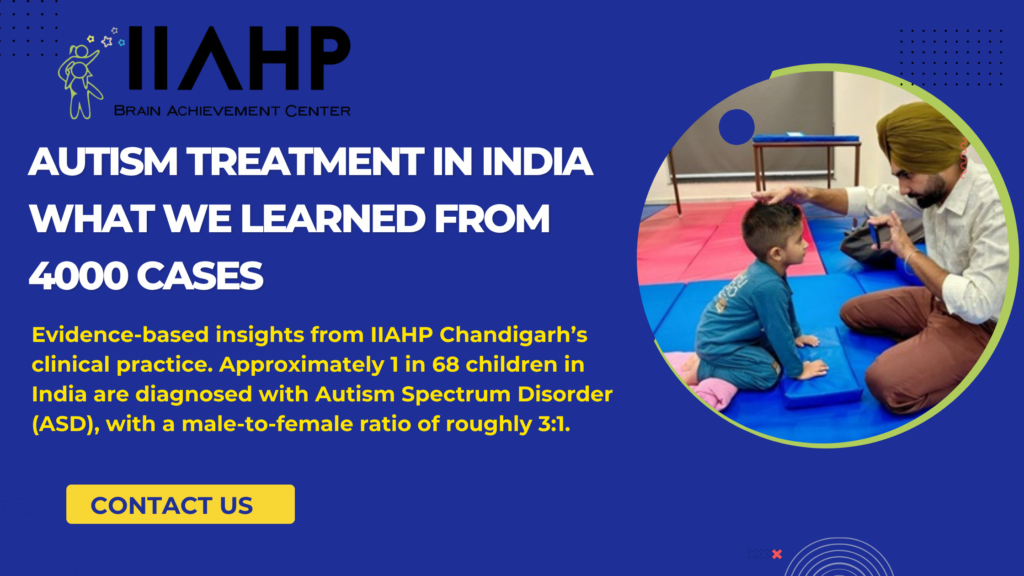
Approximately 1 in 68 children in India are diagnosed with Autism Spectrum Disorder (ASD), with a male-to-female ratio of roughly 3:1. Yet the infrastructure to support these families has grown far slower than the numbers.
Three structural problems define the landscape today:
- Late diagnosis — many children are not assessed until age 4 or 5, when the most neuroplastic intervention window (ages 2–3) has already passed.
- Fragmented care — therapists across disciplines often work in silos with no integrated programme.
- Regional inequality — families in Tier-2 and Tier-3 cities face months-long waiting lists or zero access to qualified practitioners.
Chandigarh serves as a healthcare hub for a combined population across Punjab, Haryana, and Himachal Pradesh more India as well as world provide home plan.
Key Figures from Our 4000-Case Review
| Metric | Finding |
| Average age at first IIAHP intake | 3.8 years |
| Children who began therapy before age 3 | 22% |
| Children referred after age 5 | 41% |
| Families travelling from outside Chandigarh | 63% |
| Children with prior single-therapy exposure only | 78% |
| Cases showing measurable communication gains within 6 months | 87% |
| Cases achieving classroom readiness within 18 months | 54% |
| Children who required no medication throughout treatment | 100% |
| NOTE | IIAHP operates an exclusively drug-free, therapy-based model. Every child in our 4000-case review completed their programme without pharmaceutical intervention. |
What Actually Works — IIAHP’s Integrated Therapy Model
Most autism blogs in India list generic therapy names without explaining how or why they produce results. What they also miss entirely is the integration logic — how therapies must work together to address autism as the multi-system condition it is. IIAHP does not offer any single behavioural therapy in isolation. Here is what our clinical programme actually comprises.
1. Sensory Integration Therapy
Sensory processing dysfunction is present in the overwhelming majority of children with ASD. Before a child can engage in communication or social learning, their nervous system needs to feel regulated. Sensory integration therapy — including vestibular stimulation, proprioceptive input, and tactile desensitisation — forms the foundational layer of IIAHP’s programme.
At IIAHP, sensory integration is embedded within creative expression activities: painting, drawing, and modelling. Children who were previously overwhelmed by classroom noise or physical contact show measurable improvement in tolerance and self-regulation within the first 8–12 weeks.
2. The Listening Program — Auditory Processing Normalisation
Many autistic children experience auditory processing dysfunction — certain sound frequencies feel painful, verbal instructions become difficult to process, and background noise creates persistent anxiety. The Listening Program, used by IIAHP as a structured clinical intervention, works to normalise the auditory system through precisely calibrated music frequencies.
In our case review, children who underwent The Listening Program alongside other therapies showed faster reduction in sound sensitivity and markedly improved receptiveness to verbal instruction — a prerequisite for speech progress to take hold.
3. Archetype Movement Integration
This is one of the most underused interventions in Indian autism treatment. Archetype Movement Integration activates dormant or underdeveloped primitive reflexes that, when retained beyond infancy, interfere with motor coordination, emotional regulation, and midline crossing — which is essential for reading and writing.
IIAHP introduced this technique from international practice. Children with significant motor challenges showed improved coordination, reduced impulsivity, and better classroom engagement after a structured Archetype Movement Integration protocol.
4. Vision Normalisation Program
Visual processing challenges are frequently overlooked in autism treatment. Many autistic children have difficulty with focal and peripheral vision coordination, which affects their ability to track written text, maintain spatial awareness, and engage in social eye contact comfortably.
IIAHP’s vision normalisation programme targets both focal and peripheral visual function. Improvements in visual processing often produce downstream gains in reading readiness and social attention that parents notice without always connecting to the vision work.
5. The Listening and Music Program
Music therapy at IIAHP serves dual functions: it supports emotional expression and relationship-building while simultaneously providing rhythmic and tonal input that helps regulate the nervous system. Unlike general recreational music, IIAHP’s music programme is clinically structured to target specific developmental outcomes.
Children who struggle to initiate verbal communication often find music a more accessible first channel for self-expression — and this frequently becomes a bridge toward verbal language.
6. The Intellectual and Academic Programme
One of the most damaging assumptions in Indian autism treatment is that non-verbal or minimally verbal children cannot learn academic content. IIAHP’s clinical experience flatly contradicts this.
Through a step-by-step programme in reading, mathematics, and encyclopaedic knowledge, every child enrolled in our intellectual programme has demonstrated capacity for reading recognition, basic numeracy, and money concepts — regardless of verbal status at intake. This forms the foundation for our secondary literacy and writing levels.
7. Nutrition and Gut Health Protocol
The gut-brain connection in autism is increasingly well-documented. Gut dysbiosis, food sensitivities, and nutritional deficiencies are common co-occurring factors in ASD presentations. IIAHP’s nutrition programme is a child-specific clean-eating protocol — not a generic elimination diet.
Parents consistently report visible behavioural changes — reduced reactivity, improved sleep, better focus — within weeks of dietary adjustments. This does not replace neurological therapy. It creates conditions in which therapy works more effectively.
The 5 Most Common Mistakes Families Make
These are not judgements. Every family arrives doing the best they can with the information available. But our clinical experience reveals five patterns that consistently delay or dilute treatment outcomes.
| Mistake 1 | Waiting for a definitive diagnosis before starting therapy. If your child shows developmental red flags at 18–24 months, begin early intervention immediately. Do not wait for a confirmed ASD label. |
| Mistake 2 | Choosing a centre based on proximity rather than programme depth. A centre nearby offering one session of speech therapy per week will produce different outcomes than an intensive, multi-modal programme. |
| Mistake 3 | Stopping therapy when the child “improves”. Early improvement marks the beginning of a consolidation phase — not a signal to reduce intensity. Most regressions occur after families prematurely reduce therapy hours. |
| Mistake 4 | Treating school as the primary therapy provider. Even special schools are not equipped to deliver clinical-level sensory, auditory, or movement integration. Centre-based and home-based therapy must remain central. |
| Mistake 5 | Ignoring parent training. At IIAHP, parents are active programme participants. A parent who understands the purpose of each activity delivers 4–6 hours of daily home reinforcement — something no centre can replicate alone. |
What to Expect — A Realistic Timeline
One of the most unfair aspects of autism content in India is the gap between what is implied and what is realistic. Here is what our case data actually shows.
| Timeframe | Typical Clinical Milestones at IIAHP |
| Weeks 1–4 | Baseline assessments; sensory programme begins; family orientation and parent training |
| Months 1–3 | Reduction in sensory reactivity; improved eye contact; auditory programme begins |
| Months 3–6 | Communication attempts increase; self-regulation improves; academic programme introduced |
| Months 6–12 | Vocabulary expansion; reduced stimming frequency; social interaction increases |
| Months 12–18 | Classroom readiness assessment; many children transition to mainstream or supported schooling |
| 18 months+ | Maintenance programme; independence skills; continued academic and social development |
These timelines assume intensive, consistent engagement — typically 20–30 therapy hours per week including centre-based and structured home activities. Children who begin before age 3 generally progress faster. Children who begin later also make meaningful gains — the trajectory is simply calibrated differently
The IIAHP Difference — International Techniques, Indian Context
What distinguishes IIAHP from most autism centres in India is not any single therapy — it is the integration of internationally validated techniques within a programme designed for Indian families. Several of the methods we employ are not yet widely available in India.
- Foreign therapists visit IIAHP twice annually to train our staff in the latest international techniques — including neurodevelopmental movement protocols and advanced auditory integration methods.
- Senior IIAHP staff travel abroad for advanced training, ensuring our programme remains current with global research.
- Home Plans are available via Zoom for families who cannot relocate to Chandigarh — providing therapist-designed daily programmes that parents implement at home.
- International families from the UAE, UK, and other countries have enrolled their children in IIAHP’s in-centre and remote programmes.
- All interventions are drug-free. IIAHP relies entirely on neurological stimulation, sensory integration, auditory retraining, vision normalisation, and developmental learning.
- We treat children aged 2 to 17 years and accept new enrolments year-round.
IIAHP is based at #2529, Sector 35-C, Chandigarh, with a second centre at Shivalik Vihar Road, Naya Gaon. Contact us at +91-9888612162 or info@iiahp.com.
10 Questions to Ask Any Autism Centre Before You Enrol
Whether you are evaluating IIAHP or any other centre, these questions will separate serious clinical programmes from those offering only surface-level support.
- How many therapies do you offer under one roof, and how are they coordinated into a single programme?
- Is sensory processing addressed as a standalone session or integrated across all therapy activities?
- Do you provide written home plans, and how much parent training is included each week?
- Can you share documented outcome data from past cases — even anonymised?
- What is the average therapy intensity (hours per week) for children with my child’s profile?
- How do you respond to regression or plateau periods — what does your adjustment protocol look like?
- Do your staff receive ongoing international training? When did they last update their methods?
- How do you coordinate with the child’s school or teachers?
- What is your position on medication? Is it ever recommended or required as part of your programme?
- Is remote or home-plan therapy available for families who cannot attend every day in person?
What 4000 Cases Taught Us — and What They Mean for Your Child
Every child we have treated at IIAHP has arrived with a unique set of strengths and challenges. Every family has arrived exhausted, hopeful, and desperate for clarity. After more than 4000 cases, here is what we know with confidence:
- Early intervention is the single greatest predictor of outcome — but it is never too late to begin.
- No single therapy is sufficient. Autism is a multi-system condition and requires a multi-modal response.
- Parent engagement is not optional — it is clinical infrastructure. The family is the extension of the therapy room.
- Drug-free, neurologically grounded interventions produce durable, meaningful change when implemented with intensity and consistency.