
Cerebral palsy (CP) is one of the most common motor disabilities in children, yet it’s often misunderstood. Many families begin therapy focused only on physical movement—hoping their child will walk or sit independently. While mobility is important, effective cerebral palsy treatment goes far beyond muscles and movement.
Today, advanced therapy models—like those followed at IIAHP—focus on improving the child’s overall brain function, coordination, independence, and quality of life, not just isolated physical milestones.
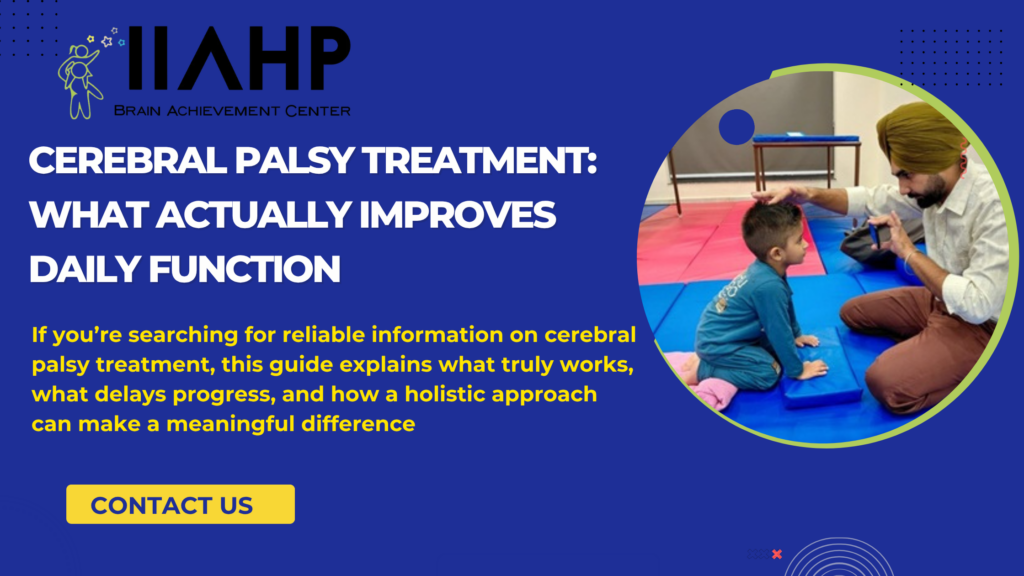
If you’re searching for reliable information on cerebral palsy treatment, this guide explains what truly works, what delays progress, and how a holistic approach can make a meaningful difference.
Understanding Cerebral Palsy
Cerebral palsy is a neurological condition caused by damage to the developing brain, affecting:
- Movement and posture
- Muscle tone (stiffness or floppiness)
- Coordination and balance
- Sometimes speech and cognition
There is no single cure, but with the right therapy, children can significantly improve their functional abilities and independence.
The Real Goal of Cerebral Palsy Treatment
Many parents initially focus on:
“Will my child walk?”
But therapists today emphasize a broader goal:
- Can the child sit with control?
- Can they use their hands effectively?
- Can they communicate and interact?
- Can they perform daily activities independently?
At IIAHP, cerebral palsy treatment is designed to improve overall brain-body coordination, ensuring progress across multiple areas of development.
What Actually Works in Cerebral Palsy Treatment
1. Neurodevelopmental Therapy (NDT)
Neurodevelopmental therapy focuses on improving:
- Posture
- Movement patterns
- Muscle coordination
Instead of forcing movement, NDT trains the brain to control the body more efficiently.
IIAHP Approach:
Therapists use structured exercises to help the brain learn correct movement patterns.
👉 Real-life impact:
Better sitting, standing, and controlled movements.
2. Sensory Integration for Better Control
Many children with CP have sensory challenges:
- Poor balance
- Difficulty processing touch or movement
- Fear of motion
Sensory integration therapy helps the brain process these inputs correctly.
At IIAHP, activities include:
- Balance exercises
- Vestibular stimulation
- Tactile therapy
👉 Real-life impact:
Improved coordination and reduced stiffness or fear.
3. Muscle Strength & Flexibility Training
Muscle tone issues in CP can be:
- Too stiff (spastic)
- Too loose (hypotonic)
Therapy focuses on:
- Stretching tight muscles
- Strengthening weak ones
- Improving joint mobility
IIAHP integrates physiotherapy with functional exercises.
👉 Real-life impact:
Easier movement and reduced discomfort.
4. Functional Skill Development
Cerebral palsy treatment must focus on real-life skills, such as:
- Sitting independently
- Holding objects
- Feeding
- Dressing
IIAHP emphasizes functional training, not just clinical exercises.
👉 Real-life impact:
Greater independence in daily routines.
5. Speech and Communication Support
Some children with CP face:
- Speech difficulties
- Oral-motor challenges
Therapies include:
- Speech therapy
- Oro-facial exercises
- Breath control training
👉 Real-life impact:
Improved communication and reduced frustration.
6. Brain-Based Stimulation Programs
Movement and cognition are deeply connected.
IIAHP uses:
- Brain Gym
- Cognitive stimulation exercises
- Coordination-based activities
These improve:
- Attention
- Learning ability
- Response time
👉 Real-life impact:
Better engagement and learning capacity.
7. Parent Training & Home Programs
One of the biggest factors in success is consistency.
At IIAHP:
- Parents are trained to continue therapy at home
- Daily routines are structured around therapy goals
👉 Real-life impact:
Faster and more consistent progress.
What Delays Progress in Cerebral Palsy Treatment
Understanding delays is crucial for better outcomes.
🔴 Common Mistakes
- Focusing only on walking
- Ignoring sensory processing issues
- Ignoring vestibular issue
- Ignoring balance and coordination issues
- Ignoring reflex Integration
- Inconsistent therapy routines
- Lack of personalized treatment plans
- Delayed start of therapy
Most importantly, treating CP as only a muscle problem—instead of a brain-based condition—limits progress.
How IIAHP’s Approach Stands Out
IIAHP’s content and therapy model focus on:
- Brain-based development
- Multi-therapy integration
- Functional independence
- Parent involvement
- Personalized treatment plans
This aligns with real parent intent:
“What will actually improve my child’s life?”
Why Early Intervention Matters
The earlier treatment begins:
- The greater the brain’s ability to adapt (neuroplasticity)
- The better the long-term outcomes
Early therapy helps:
Improve independence
Build correct movement patterns
Prevent secondary complications
The IIAHP Model for Cerebral Palsy Treatment
IIAHP provides a comprehensive, multidisciplinary approach, including:
- Neurodevelopmental therapy
- Sensory integration
- Physiotherapy
- Speech and oro-facial therapy
- Brain-based cognitive programs
- Functional skill training
Key benefits:
Focus on real-life outcomes
Customized therapy plans
Integrated treatment under one roof
Final Thoughts
Cerebral palsy treatment is not just about movement—it’s about helping a child live a more independent and meaningful life.
What truly works:
- Brain-based therapy approaches
- Consistent, structured routines
- Integrated multi-therapy programs
- Early intervention
At IIAHP, cerebral palsy treatment is designed to go beyond basic therapy—focusing on long-term development, independence, and quality of life.