

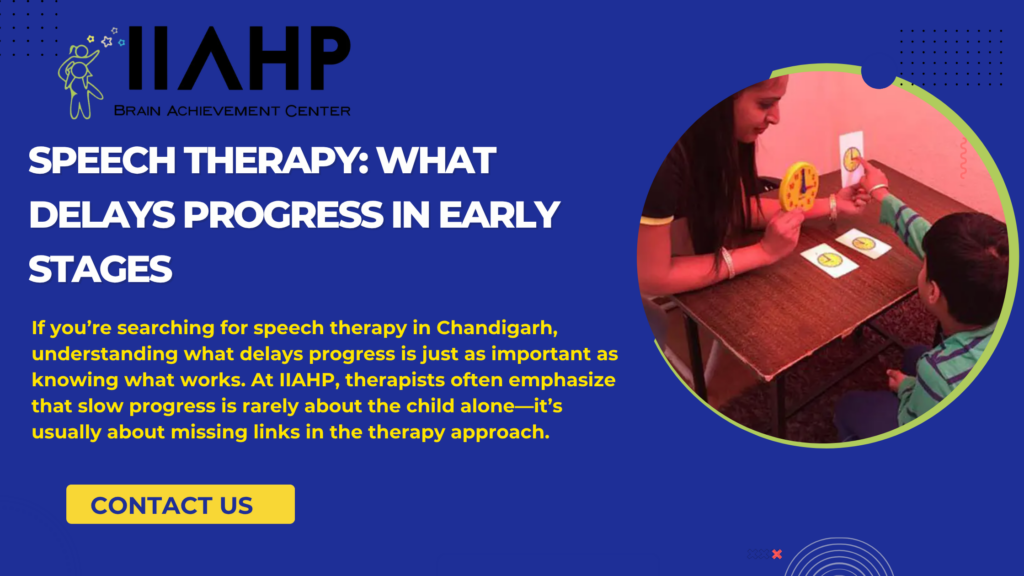
Speech therapy is one of the most recommended interventions for children facing communication challenges. Yet, many parents begin therapy with high expectations—only to feel concerned when progress seems slow in the early stages.
If you’re searching for speech therapy in Chandigarh, understanding what delays progress is just as important as knowing what works. At IIAHP, therapists often emphasize that slow progress is rarely about the child alone—it’s usually about missing links in the therapy approach.
This blog breaks down the real reasons behind delayed progress in early speech therapy and how the right strategies can change outcomes.
Why Early Speech Therapy Progress Can Feel Slow
Speech development is not just about talking—it’s about how the brain processes sound, understands meaning, and coordinates muscles to produce speech.
In many cases, children don’t respond quickly to therapy because:
- The root cause is not fully addressed
- Therapy is too narrow (speech-only focus)
- There is lack of consistency at home
At IIAHP, speech therapy is approached as part of a broader neurodevelopmental framework, not an isolated intervention.
1. Focusing Only on Words, Not Communication
One of the biggest mistakes in early speech therapy is focusing only on:
- Vocabulary building
- Repetition of words
But communication begins much earlier, with:
- Eye contact
- Joint attention
- Understanding instructions
If these foundational skills are weak, speech development naturally slows down.
IIAHP Approach:
Therapists work on pre-speech skills first, ensuring the child is ready to communicate—not just imitate words.
👉 Result: More natural and meaningful speech development.
2. Ignoring Sensory Processing Challenges
Many children who need speech therapy also face sensory processing issues, such as:
- Hypersensitivity to sound
- Poor auditory processing
- Difficulty focusing
If the brain cannot process sound properly, speech therapy alone will have limited impact.
At IIAHP Chandigarh, therapies like:
- Auditory Integration Training
- Sensory Integration Therapy
are combined with speech sessions to improve how the brain processes sound.
👉 Result: Better listening leads to better speaking.
3. Lack of Consistency Outside Therapy Sessions
A common misconception is:
“One hour of therapy per day is enough.”
In reality, progress depends heavily on daily reinforcement at home.
Without consistency:
- Skills learned in therapy are not retained
- Progress becomes slow or inconsistent
IIAHP Solution:
Parents are trained with home-based programs, so therapy continues beyond the center.
👉 Result: Faster and more stable progress.
4. Delayed Start of Therapy
Timing plays a critical role in speech development.
The earlier therapy begins:
- The higher the brain’s plasticity
- The faster the learning response
Delaying therapy can make it harder to:
- Build foundational communication skills
- Correct speech patterns
IIAHP emphasizes early intervention, especially during the critical developmental years.
👉 Result: Improved long-term communication outcomes.
5. One-Size-Fits-All Therapy Plans
Every child is different:
- Some struggle with understanding
- Others with expression
- Some with motor coordination
Generic therapy plans often fail because they don’t address the child’s specific needs.
At IIAHP, each child receives a personalized speech therapy plan, based on:
- Developmental assessment
- Sensory profile
- Cognitive ability
👉 Result: Targeted therapy leads to measurable improvement.
6. Weak Oral-Motor Skills
Speech is not just a brain function—it also involves muscle coordination.
Children may struggle due to:
- Weak tongue movement
- Poor lip control
- Low oral muscle tone
If these are not addressed, speech clarity remains limited.
IIAHP integrates oro-facial therapy, which strengthens:
- Mouth muscles
- Breath control
- Speech clarity
👉 Result: Clearer and more controlled speech production.
7. Unrealistic Expectations from Therapy
Parents often expect:
- Quick results
- Immediate word production
But speech development follows a step-by-step process:
- Listening
- Understanding
- Responding
- Speaking
Skipping stages leads to frustration and perceived delays.
IIAHP therapists guide parents on realistic timelines and milestones.
👉 Result: Better alignment and reduced anxiety.
8. Lack of Integrated Therapy Approach
Speech therapy works best when combined with other therapies.
Many children need support in:
- Cognitive development
- Motor skills
- Sensory regulation
IIAHP offers a multidisciplinary approach, including:
- Speech therapy
- Occupational therapy
- Sensory integration
- Brain-based developmental programs
👉 Result: Holistic improvement, not isolated gains.
How IIAHP Stands Out
IIAHP content and approach focus on:
- Root causes of speech delay
- Brain and sensory development
- Parent involvement
- Personalized therapy programs
This aligns better with real search intent and builds trust with parents looking for effective speech therapy in Chandigarh.
What Parents Should Focus On Instead
If your child is in speech therapy, focus on:
- Building communication, not just words
- Consistency at home
- Early intervention
- Integrated therapy approach
- Patience with the process
Final Thoughts
Delayed progress in speech therapy is not uncommon—but it is often preventable.
The key is to move beyond a narrow approach and focus on:
- Brain development
- Sensory processing
- Consistent practice
- Personalized therapy
At IIAHP Chandigarh, speech therapy is designed to address these deeper factors—ensuring children don’t just learn to speak, but learn to communicate effectively in real life.