

For many parents, the daily reality of raising a child with autism spectrum disorder (ASD) is less about labels and more about everyday moments — asking for a glass of water, greeting a family member, brushing teeth without a meltdown, or getting dressed independently before school. These small, practical skills fall into two broad categories: communication and daily living skills, and both are central to a child’s long-term independence and quality of life.
Autism treatment refers to the structured therapies and support strategies used to help children with ASD build the skills they find difficult, including speaking, understanding others, and managing routine self-care tasks. Because communication difficulties and delayed daily living skills are among the most common challenges linked to autism, many families specifically look for treatment approaches that target these two areas.
Parents, caregivers, and family members can all play a role in reinforcing progress, and children of nearly any age can benefit from support, though earlier intervention is generally considered helpful. This article answers the most common questions parents ask about whether — and how — autism treatment can improve communication and daily living skills, using clear, realistic language rather than exaggerated promises.
What Is Autism Treatment?
Autism treatment is a structured, individualised combination of therapies designed to help children with autism spectrum disorder build skills in communication, social interaction, sensory processing, and daily living. It is not a single method but a tailored plan based on a professional assessment of each child‘s specific needs.
There is no universal treatment that works identically for every child, since autism affects each individual differently. A qualified professional typically evaluates a child’s current communication ability, sensory responses, motor coordination, and independence with daily tasks before recommending which therapies to combine. The goal is steady, meaningful progress rather than a guaranteed or fixed outcome.
Can Autism Treatment Improve Communication Skills in Children with Autism?
Yes, autism treatment can help many children improve communication skills, including speech, gestures, eye contact, and understanding others. Progress depends on the child’s individual profile, the therapies used, and consistency of practice. Some children develop clear verbal speech, while others make strong progress using alternative communication methods.
Communication challenges in autism can range from a complete absence of spoken language to difficulty with back-and-forth conversation, understanding tone, or reading body language. Speech and language therapy is often central to addressing these challenges, alongside supporting strategies such as visual supports, structured routines, and sensory-based therapies that can make it easier for a child to engage and focus during communication practice. For children who are non-verbal or minimally verbal, therapists may also introduce alternative and augmentative communication methods, such as picture cards or communication devices, alongside continued speech-building work.
Can Autism Treatment Improve Daily Living Skills?
Yes, therapy can support the development of daily living skills such as dressing, eating, toileting, grooming, and following simple routines. These skills are often built gradually through structured practice, visual cues, and consistent repetition at both the therapy centre and at home, with progress varying by child.
Daily living skills, sometimes called adaptive or self-help skills, are frequently affected in children with autism because they often rely on sequencing, motor planning, sensory tolerance, and following multi-step instructions — all areas that autism can impact. Occupational-style and sensory-based therapies can help a child tolerate textures (such as clothing or toothpaste), improve fine motor coordination for tasks like buttoning or using cutlery, and build the attention needed to complete a routine from start to finish. Many centres also involve parents directly, since these skills are ultimately practised at home, not only in a clinical setting.
What Therapy Options Support Communication and Daily Living Skills?
A combination of therapies is generally used to build communication and daily living skills, including speech and language therapy, sensory integration therapy, reflex integration, floor programs for motor and coordination development, vision-based therapy, and structured behaviour or routine training. A professional selects and combines these based on individual assessment.
Depending on a child’s specific goals, a plan may include:
- Speech and Language Therapy — builds verbal communication, vocabulary, understanding of instructions, and conversational back-and-forth.
- Sensory Integration Therapy — helps children manage sensory input that may otherwise interfere with focus, comfort, or willingness to try new tasks like grooming or eating.
- Reflex Integration Therapy — supports the maturing of early reflexes that, when retained, can affect coordination needed for self-care tasks.
- Floor Program (Vestibular, Proprioceptive & Spatial Training) — builds balance and body awareness, which underpin motor planning for daily tasks such as dressing.
- Vision-Based Therapy (including Prism Therapy) — supports eye contact, visual tracking, and hand-eye coordination used in tasks like eating or writing.
- Brain Gym and Balance Board Activities — movement-based exercises that may support coordination and processing needed for multi-step routines.
- Behaviour and Routine-Based Training — structured, non-invasive guidance to help a child follow sequences, transitions, and everyday routines independently.
These approaches are typically offered as a drug-free, therapy-based path rather than through medication, and a qualified professional can advise which combination suits a particular child’s needs.
How Does Professional Therapy Help Build These Skills More Effectively Than Home Efforts Alone?
Professional therapy offers structured, repeated practice designed around a child’s specific developmental profile, delivered by trained therapists who can adjust techniques in real time. This targeted, consistent approach can help children make steadier progress in communication and daily living skills than unstructured practice alone, though home reinforcement remains an important part of the process.
Learning a new skill — whether it’s forming a sentence or buttoning a shirt — usually requires breaking the task into smaller steps and practising them in a predictable order. Trained therapists are skilled at identifying exactly where a child is struggling within a task, adjusting the difficulty level, and using techniques suited to how that particular child learns best. This professional guidance, combined with consistent practice at home, tends to produce more reliable progress than either approach used alone.
When Should Parents Seek Professional Support for Communication or Daily Living Delays?
Parents should consider a professional evaluation if a child is not using words or gestures by the expected age, struggles to follow simple instructions, resists basic self-care tasks like dressing or brushing teeth, or shows a noticeable gap compared to peers in independence. Earlier evaluation generally allows more time for structured support.
Signs that may point toward the need for an assessment include:
- Little to no meaningful speech or gesture use by 18–24 months
- Difficulty understanding or following simple, one-step instructions
- Strong resistance to routine self-care tasks such as brushing teeth, dressing, or eating
- Difficulty with transitions between activities or tasks
- A noticeable gap between the child’s independence level and that of same-age peers
If these patterns are present, speaking with a paediatrician or developmental specialist is a reasonable next step. An evaluation helps clarify whether therapy could help and, if so, which areas to prioritise first.
What Happens During a Therapy Session Focused on Communication or Daily Living Skills?
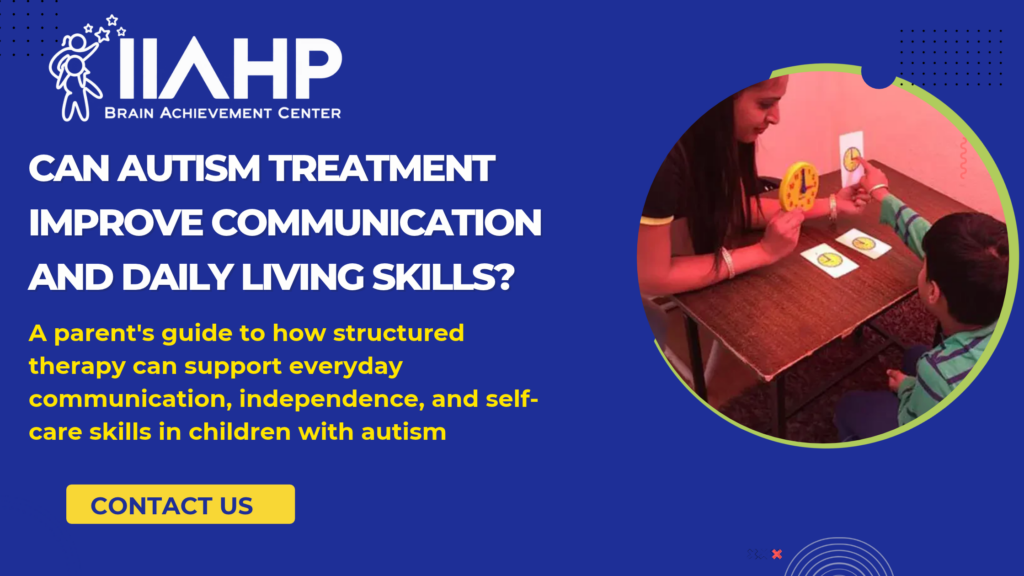
A typical session usually begins with a warm-up to help the child settle, followed by structured, play-based activities targeting a specific goal — such as naming objects, following two-step instructions, or practising a self-care routine like washing hands. Therapists observe closely and adjust the activity based on the child’s response.
Because plans are individualised, a session working on communication might involve picture cards, turn-taking games, or guided conversation practice, while a session focused on daily living skills might involve hands-on practice with dressing, eating with utensils, or following a visual schedule for a morning routine. Repetition, positive reinforcement, and a calm, predictable setting are common features across most sessions, since children with autism often respond well to consistency.
How Long Does It Take to See Improvement in Communication or Daily Living Skills?
There is no fixed timeline, as progress depends on the child’s age, the severity of the challenge, and consistency of therapy and home practice. Some families notice small, encouraging changes within a few months, while more significant or lasting gains — especially in complex communication skills — can take a year or longer of sustained effort.
Communication and daily living skills often improve unevenly rather than in a straight line. A child might make quick progress with a specific self-care task while spoken language develops more gradually, or vice versa. Consistency between therapy sessions and home practice tends to support steadier progress than occasional sessions alone. A qualified professional can offer a more specific estimate after directly assessing a child, but responsible practitioners avoid promising a fixed recovery timeline.
How Can Parents and Caregivers Support Communication and Daily Living Skills at Home?
Parents can reinforce progress by practising the specific words, gestures, or self-care steps recommended by the therapy team, keeping daily routines predictable, using visual schedules, and giving the child time to attempt tasks independently before helping. Consistent, patient reinforcement at home can meaningfully support what happens during formal therapy sessions.
Practical ways to reinforce these skills at home include:
- Narrating daily activities out loud to build vocabulary naturally (“Now we’re washing our hands”)
- Using simple, consistent language and allowing extra time for the child to respond
- Breaking self-care tasks into small, visual steps, such as a picture sequence for getting dressed
- Keeping routines predictable so the child knows what to expect and when
- Allowing the child to attempt tasks independently first, offering help only when needed
- Celebrating small wins to build confidence and motivation
Staying in regular contact with the therapy team helps ensure that home practice lines up with what is being worked on professionally, rather than working at cross purposes.
How Do You Choose the Right Therapy Centre for Communication and Daily Living Goals?
Look for a centre with qualified, experienced therapists, a thorough individual assessment process, therapies specifically suited to communication and daily living goals, transparent communication about realistic outcomes, and a clear system for tracking progress. Avoid centres that promise guaranteed results or a fixed recovery timeline.
Questions worth asking include:
- Does the centre assess communication and daily living skills specifically, or only general behaviour?
- What therapies are recommended for my child’s particular goals, and why?
- How often is progress reviewed, and how is it shared with parents?
- Are parents trained or guided to continue practice at home?
- Is support available remotely for families who cannot visit often?
A transparent centre will explain its approach clearly and set realistic expectations rather than making broad promises.
Is Support for Communication and Daily Living Skills Available Remotely?
Yes. Many therapy centres, including IIAHP Chandigarh, offer structured home-based programs guided over video calls, where parents are trained to practise specific communication and daily living exercises at home between periodic reviews.
This option can be useful for families who live outside the city, in another state, or abroad, and cannot attend in-person sessions regularly. It generally works best when parents can commit to a consistent home routine and maintain regular contact with the therapy team for feedback and adjustments.
Moving Forward with Realistic Expectations
Communication and daily living skills form the foundation of a child’s everyday independence, and structured, individualised autism treatment can genuinely help many children make progress in both areas. Results vary from child to child, and no responsible professional can promise a specific outcome or timeline — but consistent, well-matched therapy combined with supportive practice at home gives children the best opportunity to build these skills over time.
If your child is facing challenges with communication or everyday routines, the most useful next step is a professional assessment. IIAHP Chandigarh works with children from 2 years to 17 years of age, using an individualised, drug-free, therapy-based approach, along with home-based programs over video calls for families who cannot visit regularly. A qualified professional can evaluate your child’s specific needs and recommend a realistic, personalised plan.
To learn more or discuss your child’s individual needs, visit www.iiahp.com
Frequently Asked Questions
This depends entirely on the individual child, and no professional can guarantee spoken language for every child. Many non-verbal children make meaningful progress in communication over time, sometimes through spoken words and sometimes through alternative methods such as picture-based systems or communication devices. A qualified speech and language therapist can assess your child directly and set realistic, individual goals.
Not usually. Communication and daily living skills often overlap and are frequently addressed together, since following instructions, expressing needs, and completing routines all rely on related underlying skills. Most therapy plans address both areas in a coordinated way.
Yes. While early intervention is often emphasised, children and teenagers of various ages can still make progress in communication and daily living skills with appropriate, individualised therapy. Centres such as IIAHP Chandigarh work with children from 2 years to 17 years of age.