

Children, especially those on the autism spectrum, often learn differently from their peers. Traditional one-dimensional teaching methods may not always engage their full range of abilities. That’s where multi-sensory activities come in — offering rich, varied sensory experiences that help build stronger learning skills and better brain processing. For parents seeking autism treatment in Chandigarh, understanding the value of multisensory approaches can make a significant difference in your child’s development journey. At IIAHP, multi-sensory activities are integrated into therapy plans to support children’s cognitive, motor, communication, and social skills. These activities engage multiple senses — sight, sound, touch, and movement — creating engaging and effective learning experiences.
What Are Multi-Sensory Activities?
Multi-sensory activities use more than one sense at a time to help children explore, process, and learn. For example, a session might combine visual cues (like colorful images), auditory input (like rhythm or music), tactile experiences (textures or play materials), and movement (balancing or coordination tasks). These activities aren’t just “fun play” — they’re structured therapeutic tools that enhance learning by stimulating several areas of the brain simultaneously. When multiple senses are involved, the brain forms stronger neural connections, making learning more effective and long-lasting.
Why Multi-Sensory Activities Matter for Children with Autism
Children with autism often face challenges with sensory processing, which means their brains may have difficulty interpreting and integrating information from their senses. This can affect attention, communication, social interaction, and learning. Multi-sensory activities help bridge this gap by creating structured experiences that encourage the brain to respond to and integrate sensory information more efficiently.
Some key benefits include:
Enhanced Learning and Memory
Engaging multiple senses helps children experience concepts rather than hear about them. When children see, touch, move, and listen at the same time, their brains have multiple pathways to store and recall information — improving retention and comprehension.
Better Attention and Focus
Multi-sensory activities are especially helpful for children who struggle to maintain attention. Varying the sensory input keeps activities engaging and can help children stay focused longer, which is key for learning and skill development.
Improved Social and Communication Skills
Activities involving music, group play, or shared storytelling encourage interaction. These shared sensory experiences often enhance social engagement, turn-taking, and communication — all crucial for children undergoing autism treatment.
Motor Coordination and Sensory Regulation
Activities that involve movement — like balance board tasks, rhythmic exercises, or tactile play — help children improve coordination, body awareness, and sensory regulation. These gains often support better participation in daily routines and academic tasks.
How IIAHP Uses Multi-Sensory Strategies for Autism Treatment in Chandigarh
At IIAHP, multi-sensory activities are an integral part of a comprehensive autism treatment strategy that focuses on the whole child. Rather than isolating individual skills, IIAHP blends sensory-rich experiences into therapy sessions designed to strengthen brain function and learning readiness.
Here’s how IIAHP incorporates sensory-focused activities:
- Art & Sensory Integration — Children explore textures, colors, and creative expression, which supports emotional regulation, fine motor skills, and sensory processing.
- Balance Board and Movement Activities — These help with coordination, vestibular awareness, and sequencing — all essential for learning readiness.
- Brain Gym Exercises — Designed to stimulate both hemispheres of the brain, these activities improve attention, memory, and cognitive organization.
- Auditory and Audio-Visual Training — Combining sound and visual input supports auditory processing, listening skills, and visual tracking — fundamentals for reading and communication.
Each activity is selected based on a child’s unique strengths and challenges, creating a personalized therapy plan that supports optimal developmental progress.
Final Thoughts
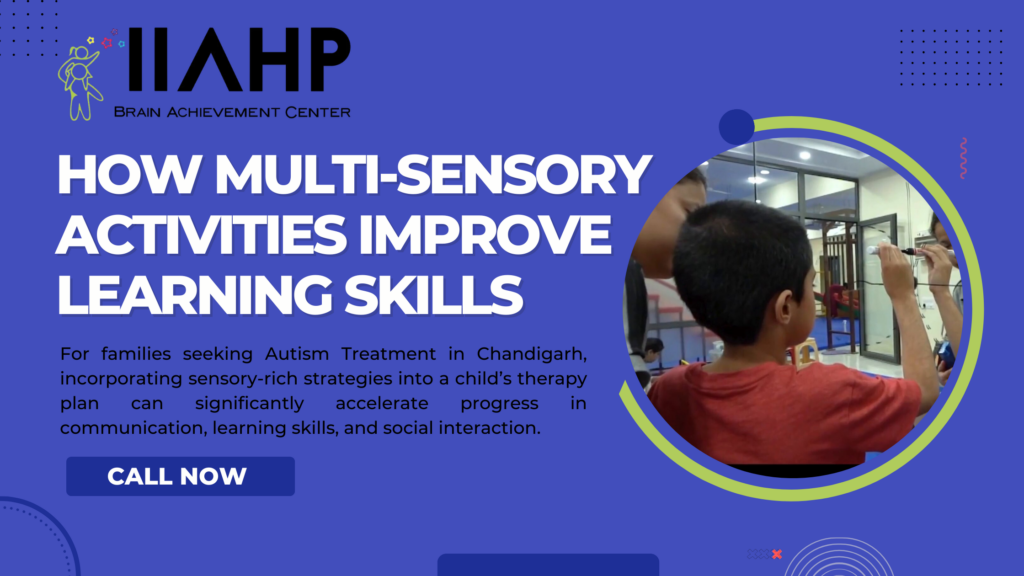
Multi-sensory activities are not just enjoyable — they are powerful tools that enhance learning, processing, and engagement for children with developmental needs. For families seeking Autism Treatment in Chandigarh, incorporating sensory-rich strategies into a child’s therapy plan can significantly accelerate progress in communication, learning skills, and social interaction.
With its holistic, child-centred programs, IIAHP offers multi-sensory therapy approaches that help children reach their full potential — empowering families every step of the way.